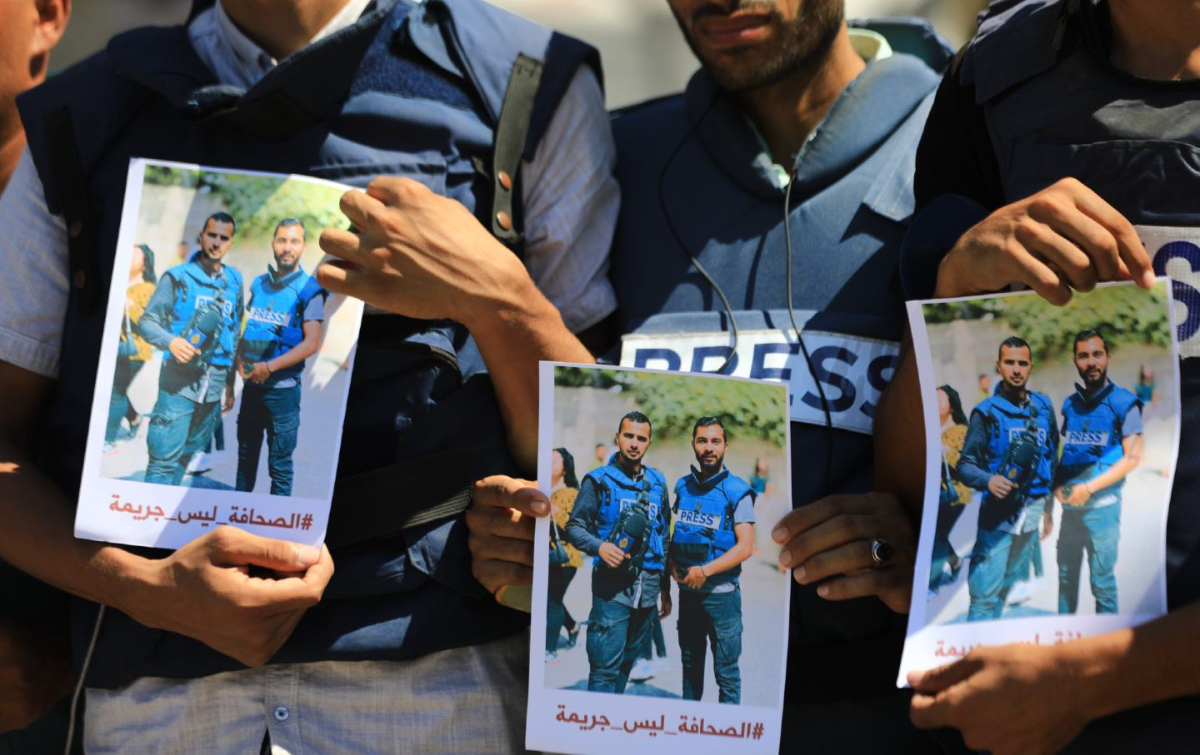
I co-authored this piece with Chip Gibbons in The Nation, “More Than 100 Journalists Come Together With Their Fellow Journalists in Palestine and Against US Complicity in Their Killing,” about our joint effort to organize journalists to speak out en masse, writing to the State Department demanding an immediate U.S. arms embargo on Israel over its genocide in Gaza.
Author: Nathan
For Peter
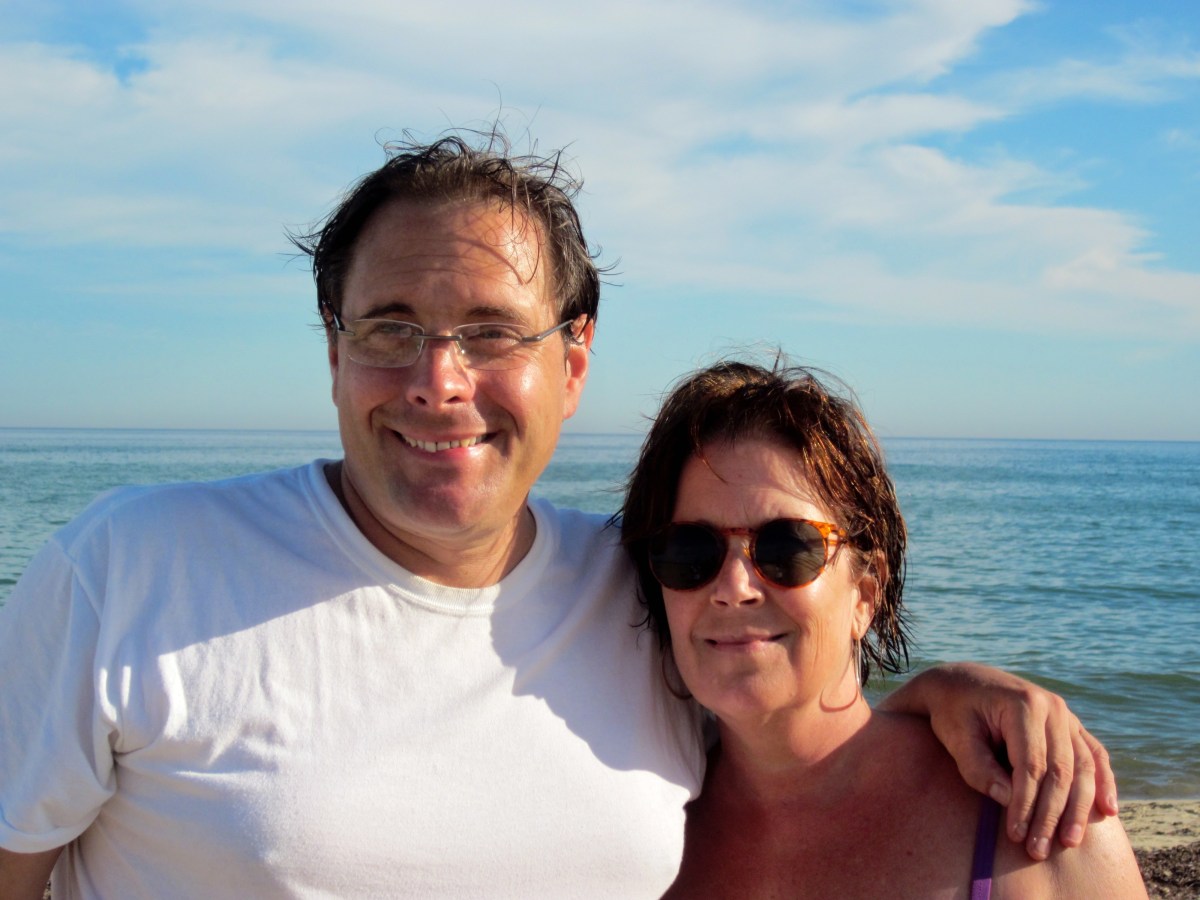
Peter died last week. It shouldn’t be a shock — he spent the last three years beating back the restrictive clutches of Parkinson’s Disease and the last year and a half in and out of the hospital trying to keep cancer at bay, if never sending it all the way out to sea — and yet it comes crushing. It’s too unfair, too cruel.
His weight was halved, his voice was stolen, and his entire life was unceremoniously heaved out of the classroom and into the ICU. Surely the reward for enduring such a medical onslaught must be freedom, must be a chance to stand over it afterward and laugh, or to explain to his family just how scary it is to be intubated, or to sit in his backyard without dreading another CAT scan. I have to remind myself that however deprived we feel, he is, at least, free from pain, from discomfort, from wondering miserably how much of his life he’ll ever get back.
My mom took such good loving care of him, leading the fight for his health and then for his life and finally for a peaceful death, and, getting him to the right doctors and asking the right questions, she’s the reason his last year of radiation and rehab was spiked with hope and light and love.
Now those of us who knew and loved him get to learn from Peter, the great teacher who always taught by example more than lecture, the artist who never stopped creating.
Let’s remember his wisdom, his perspective, his ability to never let the most important things in life stray out of focus, to see the forest and the trees. Let’s remember his humor, his unfailing readiness to laugh, how he could pierce grief with a joke when you needed it most, how he could see a rock bottom as a starting line. Let’s remember his ability to make art out of everything, to learn from mistakes without wallowing in them, to decide what really matters and pursue it relentlessly, heart first.
He loved my sisters and me and my mom with his whole heart. We never really called him ‘stepdad,’ and he hated the term anyway. He was always just Peter, always his own thing, always ready to listen and to talk, always loving. And for that I’ll always be grateful.
Tributary

I have lusted after rivers
etching Picassos into hillsides,
mapping a handvein future we won’t understand
until it’s history.
I’ve been lured downwind and downslope,
fumbling across moss rocks and pebblebrook
to be enveloped in a tributary’s yawn.
I’ve made withdrawals from riverbanks
that I can never repay,
save for deposits of flat stones
I’ve taught loved ones to skip softly.
and when it was time to leave,
I’ve tarried knee-deep
where the current slows to a pool,
where the water at my shins is warm and still,
but my feet can still feel the low cool tug.
Mantras
i’m eating a donut in the shower
and reciting your poetry like a spell,
hoping desperately to conjure
your amused apparition
halfway through your chapbook
i can see your edges,
a chalk outline that fled its inceptive scene
your stanzas mark time on a calendar
less gregorian than lunisolar,
tracking the full moons since we fell in love—
and look how far the dippers have moved.
i come to the last verse
that you finished in the village,
transcribing the arched Empire
as it crooned low
in magic hour
your best lines become my mantras,
soulfood when i’m hungry and
sleepchants when i’m lying awake,
and now finally, refrain, i can
see your face
The best show not on TV
TV critics are open to the idea that a web series could be the best show around. They’ve just picked the wrong one. According to Metacritic, critics’ favorite new show this fall is Amazon Video’s Transparent (admittedly a brilliant title), a show about Mort Pfefferman’s announcement to his adult children that he’s actually Maura, a woman. I must be missing something, but I don’t see what they’re seeing. It can’t just be that critics are eager to praise a show for finally foregrounding a trans character: they’ve already fallen all over themselves for prison-joke-show Orange is the New Black, which, like Transparent, never seems to be sure if it’s a comedy or a drama and therefore suffers when it tries to be either. In the latter, Jeffrey Tambor plays Mort and Maura, and he’s a pleasure to watch, but he doesn’t have much to work with: his children are entitled, upper-class Californians who don’t want to learn or change and we wouldn’t want to relate to even if we could. The writing is often clumsy; in the first four episodes (which critics saw for initial reviews) I’ve cringed at least once in every scene without Tambor.
The web series that everyone should be talking about (and some people were talking in 2012-13, but not enough) is High Maintenance, on Vimeo. Metacritic doesn’t aggregate reviews for it, even though it’s been extolled in the New Yorker, the New Republic, Slate, and elsewhere. (Note: I emailed and tweeted to Metacritic inquiring about the absence and haven’t heard back.)
 High Maintenance’s running thread is The Guy, an anonymous pot dealer played by show co-creator Ben Sinclair, who bikes to deliver to each episode’s real main character. Some characters recur, starring in some episodes and in the background of others. Every episode is funny, insightful, thoughtfully constructed and scored and filmed. None are really about marijuana, but several characters use it in various ways: as a crutch, conversation starter, self-medication, escape. But that’s rarely the point either. Most bring a life lesson of sorts, and character insights, but they’re conveyed as casually as The Guy slipping you an eighth, with enough respect for the audience not to beat us over the head.
FX courted Sinclair and Katja Blichfeld, his wife and co-creator, for a cable deal, but thankfully they stayed online. For High Maintenance’s newest season, you’ll have to pay per episode or, the better deal, for the full season, but it’s well worth it.
Previously, episodes ranged from 5 to 16 minutes long, and the first few of the new season are a little longer, 14-18. Vimeo is releasing these new episodes in bursts: the first three are out now, the next three are out in January, and so forth.
The first episode of the newest season is the best, while the other two are good examples of what happens when the series strays from its strengths. Watch the shows first if you want to avoid spoilers. In the first episode, “Ruth,” The Guy connects two of his clients, both single New Yorkers looking to be matched up. They have a nice first date, but no sparks fly — no big risks were taken, but they both felt comfortable: they smoked in the park, asked bizarre questions, shared a goodnight kiss. Then it turns out she kept a secret that The Guy accidentally spilled: she had stomach cancer. On their second date, while cooking peppers, the man tries to hide that he knows, the woman confronts him, and tension holds. Just at that moment, when their potential energy is waiting to be released or made kinetic, he goes to the bathroom, and gets jalapeño on his dick. The night’s plans are ruined, made both more and less intimate than planned. They share a hilarious recovery, she spends the night, and there’s a poignant turning point the next morning.
The subtle point, narratively, is that The Guy set them up and almost derailed their connection, but his returning to the story kept it moving. The Guy is the audience conduit, the interlocutor, keeping it real. He’s always insightful, always knows what to say. He meets New York’s weirdest but refuses to judge, instead indulging those who sometimes order weed just to socialize. His relative absence from the next two episodes allowed them to drift into caricature.
In “Genghis,” an asexual white magician named Evan quits his boring job to assistant teach underprivileged black kids in Brooklyn. Aside from his sexual non-orientation, this one hits all the stereotypes: the black kids don’t give a shit, the regular teacher doesn’t care either, and the white guy is doofy and everyone laughs at him. At conferences behind the scenes, Evan learns that all the teachers are resigned to prejudice and discipline and have given up on teaching and positivity. The episode’s best line is a throwaway by none of the main characters, delivered in sign language: a rejected actor signs, “I thought doing that fat girl monologue from Louie was such a good idea.” The lesson here is that Evan needs to grow up, but it’s too obvious: we get that he’s childish, after montages of him playing games, doing magic tricks, and watching cartoons, that’s plenty clear. The message is sent when it’s mirrored by his childlike naivety in thinking he could stroll into Brooklyn and make a difference. Had The Guy been more involved earlier on, he could’ve told Evan that sooner. He may not judge, but his wisdom is worth listening to.
In “Geiger,” a woman’s extended nightmare about her boyfriend becoming an extreme survivalist is echoed uncannily in real life. In the dream, which takes up the first half of the episode, fiancé Andrew delves into the world of preppers, and persuades Lucy to become hyper-prepared too. When she wakes up, she smokes a bowl, and maps out their wedding seating with Post-Its. The next day, he drops a wildly unsubtle line, “It’s not the end of the world.”
Then the focus shifts to her anxiety, with Andrew asking if she took her Xanax, and then calling up The Guy, saying Lucy “needs it.” Andrew pressures him for a pound of weed, and when he won’t go for it, Andrew wants his seller’s information. The Guy tells him he can get seeds online, and Andrew becomes obsessed. The fable about how over-focusing on the future prevents you from appreciating the present is far too heavy-handed to enjoy. We got the message in both halves (the dream and reality), didn’t need both, and either one could’ve been cut down. What would’ve been more effective is to cut out the dream and instead draw out The Guy’s concurrent story, in which he visits an AMSR YouTuber and tries to understand her process. Just those few seconds are the episode’s best. The YouTuber is Andrew’s extreme opposite, completely in the present moment, enjoying how the weed bag’s crinkle triggers a “wonderful” sensory reaction. Cut back to Andrew, whom we assume Lucy will soon be leaving. The contrast would’ve still made Andrew’s obsession unnerving, but the lesson wouldn’t be so clumsily implied.
But none of that takes away from the touching, understated lyricism of “Ruth,” nor from High Maintenance’s past episodes, filled with touching, understated moments. In “Stevie,” The Guy offends an uptight client when he reads her pill bottle, but he’s quickly disarming, and by the end of the seven-minute episode, the phone she couldn’t put down before she’s now throwing in the toilet. In “Jonathan,” a dissatisfied comedian suddenly has to cope with an act of violence. Each one is subtle, different from the rest, and different from anything on TV.
Maybe some critics aren’t giving it the time of day because some episodes are so short, some just a few minutes long. But consider the way Louie, heralded as narratively groundbreaking, comprises two 15-minute segments (with commercials, so closer to 11). And why should High Maintenance have to fit into cable-TV lengths? That was likely an enticing point of avoiding FX’s offer — the freedom to end episodes when the stories end, no filler needed. It is this type of consideration that makes High Maintenance well worth your time, and worth a little more of TV critics’ attention.
Exclusive interview with PayPal 14 lawyer Omar Figueroa
“corporate America uses the U.S. Attorney’s Office and the Federal Bureau of Investigation as their private security firm”

In 2010, thousands of people launched distributed denial of service attacks against the websites of PayPal and other financial companies in retaliation for those companies’ extra legal blockade of WikiLeaks upon the publication of war logs and diplomatic cables revealed by Chelsea Manning. PayPal said that its website was never actually down, but in court, alleged more than $5 million in damages. Fourteen people were arrested for the action and charged under the Computer Fraud and Abuse Act. Thirteen of those men and women pled guilty. Eleven of those took felonies on their records, avoiding jail time, but owing a collective total of about $80,000 in restitution to PayPal. The other two served short jail stints instead of having felonies on their records. On October 29, 2014, with the judge in their case retiring, each defendant with a felony had that count dismissed. They paid what they could at the time and each worked out a time frame to pay the remainder, with most owning about $100 per month. One of those activists is Vincent Kershaw. His lawyer is Omar Figueroa, and now that sentencing is over, Kershaw and his legal representative are more free to discuss the case.
Nathan Fuller: So, Omar, thanks for talking to me today and if you could start off just by telling me, who is Vincent Kershaw?
Omar Figueroa: Vincent Kershaw is an individual who lives in Colorado and he was an activist was indicted by the Federal Government for allegedly participating in this distributed denial of service attack.
Why is this case — why are the PayPal 14 and their case important?
This case is important because it sheds light on the abuse of corporate power and how corporate America uses the U.S. Attorney’s Office and the Federal Bureau of Investigation as their private security firm.
We know that PayPal is involved, but can you tell us how PayPal and then eBay were involved in this case?
Yes, PayPal was involved. What triggered all this was that PayPal stopped accepting donations made to WikiLeaks, around the time of the Julian Assange controversy and they extra-legally decided to stop accepting payments and these were gonna be donations for what I think is a good cause. First Amendment related activities to disseminate information and to keep secrets from being kept from the American people. Basically, an attempt to shed light on government action. And PayPal was part of the coverup.
What role exactly did they play against the defendants in this case?
PayPal called itself the victim in court, and so they’re the ones who were telling the U.S. attorneys what would be an acceptable outcome for them and what the amounted restitution was. Their role in the litigation was not as active as it would have been had the case gone to trial. So mostly they played a behind-the-scenes role. They were considered the victim.
We saw via Alexa O’Brien’s Daily Beast article that they alleged more than $5 million in damages, but we saw statements from PayPal representatives saying that their website was never actually down. Can you talk about what kind of damages that they are alleging, or was that all behind the scenes?
That was mostly behind the scenes, but they were alleging an impairment to their system, and it’s really funny, because the reports that they filed with the Securities and Exchange Commission claimed that there had been no actual damages and that would have come out at trial. We would have impeached PayPal with their own SEC filings had the case proceeded to trial. I think that was partly why we were given such an unprecedented deal. To correct what you had said about felony on the record — the defendants, the eleven defendants who entered pleas of guilty to a felony charge were never sentenced on those pleas. They were later allowed to withdraw their pleas. Technically, they don’t have any felonies on their record and never did because there cannot be a felony conviction until sentencing. So it is a two-step process. Step 1: Enter a plea. Step 2: Get sentenced. The way the deal was structured, they only went forward with Step 1, they entered a felony plea. They were basically given a time-out. After they completed their time-out, the felony plea was dismissed, and all that remains on the record is a misdemeanor conviction.
Thank you for clearing that up. eBay, as I understand it, is the parent company of PayPal. Were they playing any kind of behind-the-scenes role as well as you understood it?
Not as active as PayPal. As a parent company I think they had corporate counsel but that was probably working with PayPal, but they did not have a prominent role in the litigation.
OK, because we know that Pierre Omidyar, who is on the board of PayPal, made comments later on. He was calling for leniency for the PayPal 14, but the way that he phrased it, he still said that the PayPal 14 had excessive impact and he still kind of accepted the logic of the Computer Fraud and Abuse Act. Do you have any comments on his comments?
Ah, yes. I think he should step up and pay the restitution for the PayPal 14 if he’s truly honest that this case was over-prosecuted. I think if he can put his money where his mouth is, we invite him to do so.
I spoke to another defendant, Mercedes. She was talking about the enormous restrictions placed on the defendants. I was wondering if you could go into detail — some of the restrictions placed on the defendants before sentencing.
Oh, yes. They have numerous conditions of pre-trial release, such as checking in with pre-trial services. It’s basically like being on probation. Many people think that in America you are innocent unless proven guilty, but in the Federal system you are put on probation from day 1. It’s called pre-trial supervision and it is burdensome and onerous as being on probation. It is almost like you are put on probation before you are ever convicted. So the conditions for my client, Vincent Kershaw, also included a ban on being on IRC. He could not be on any IRC activity at all. He was also banned from Twitter. We successfully challenged the ban on IRC — I’m sorry, we successfully challenged the ban on Twitter … but the court did not lift the ban on IRC. I think this is the first case where somebody’s right to tweet was recognized by the courts.
Mercedes was also talking about how these restrictions kind of broke up their social circle. I mean, before these restrictions, this group was their friend circle and so they were not allowed to talk to one another. That really broke them down. Did Vincent suffer from that as well?
Yes. All the defendants had a restriction that they would not communicate with each other unless in the presence of counsel. Basically, it eliminated any relationships that they had if they can’t communicate. Communication is key to maintaining social relationships. Basically, when they are forbidden from talking to their friends it’s going to have a detrimental impact. It’s almost like being grounded by Big Brother.
Has Vincent talked about how happy he is to have that freedom since the sentencing?
Yeah, Vincent was very happy to be able to communicate and to renew those relationships that had been idle. It’s very liberating. I think there is something very oppressive about feeling that the government could be monitoring you. They have the duty, the right to monitor you, and they don’t want you to communicate with your friends. It just feels extremely intrusive. We did our best to fight against that, but that is what the Federal system has come down to. When people are charged in a Federal crime, usually they are forbidden from communicating with their co-defendants.
So at least he does have those restrictions removed. But he does have some money owed left. Is that correct? How much money does he still owe?
He still owes $5600.
And is that on a payment plan?
Yes. The payment plan is going to be $100 a month for the duration of probation which is going to be about twelve months. We anticipate that if he doesn’t pay that off before the probation expires, that the restitution amount, $5600 or whatever is left, will be converted into a civil judgement. That civil judgement cannot be discharged in bankruptcy. So he has to pay it at one point in his life. It is very important for him to try to get it paid off as soon as possible so that he can be a free person again.
I was speaking also to Mercedes and it sounded like there was some surveillance, at least financial surveillance as the government was monitoring the defendants to make sure that they were at least looking for work to attempt to pay restitution. Do you know if that was the case and, if so, is that still the case?
My understanding is that right now the only condition is that they pay but not like they have to get a job or they have to do something in particular. I can only speak to Vincent Kershaw. He doesn’t have any conditions other than make his payments. Once he’s done making his payments, probation will be terminated. That’s why it’s so important that the funds be raised as soon as possible so that these people who have been under very restrictive conditions for four years can be set free as soon as possible. They’ve served their time and then some. They’ve already done four years probation.
Where can people who support the PayPal 14 — can people donate to them?
Absolutely. I think there is a PayPal 14 website and there is also a foundation in Germany that is helping with the fundraising. As well, the defendants are embarking on a fundraising project that is going to involve them auctioning off the computer equipment that they obtained from the FBI, that they got back from the FBI.
They’ve already all received that equipment back?
I can speak for Vincent Kershaw. He received his equipment back, yes.

So that auction will happen soon, I hope.
Yes. The auction will probably be started on eBay, the parent company of PayPal, ironically enough.
We were also discussing about the defendants’ collective options as far as saving up money to liberate one of them or whether they want to liberate each of them individually. Do you know if they have come together to discuss that or whether that is something they are going to do in the future?
They are going to discuss that in the future. For now the default is going to be that nobody is free until they are all free. But they are talking about maybe establishing a lottery so that those who can be off probation can get off probation and they can still help the rest with the fundraising.
That would be great. Is there anything else you want to add, Omar?
Yes. I think that the point of this case — it goes back to WikiLeaks, it’s about transparency in government. It’s about people engaging in nonviolent civil disobedience. This case, the distributed denial of service attack, I see it not as breaking and entering or as a physical trespass. It’s more akin to a game of Ding, Dong, Ditch, where somebody is ringing the doorbell. The response by the federal government was disproportionate. It just seems to me that it was a tremendous waste of taxpayer dollars to go after nonviolent, good-intentioned people who are standing up for what is right.
As far as I understood it, thousands of people took part in that action and only 14-
Absolutely, it was really arbitrary who was selected by the government. The people who operated the botnets and who were responsible for the most pings, those people were never arrested, were never brought before the court. They got off scot-free. They just went after the little fish. The little fish they were able to catch but the big fish got away.
These 14 were seemingly selected at random?
It seems like it to us. We couldn’t really find any — it’s just whoever they are able to catch.
Seemingly disproportionately prosecuted as a potential deterrent is you’re understanding?
Oh, yes. They wanted to make a big example out of them.
Do you think they succeeded in that or do you find there is more support for the PayPal 14 and more people are inspired to support them?
I think they did not succeed. I think there is more support. If anything, this case has set a precedent for future activists because they are going to want the same deal that the PayPal 14 got, which is a time-out with a misdemeanor at the end and no felony convictions. I think even that is draconian because the Computer Fraud and Abuse Act used to require malice. When the government was not able to get convictions because they couldn’t prove malice, they dropped the malice requirements. Initially it was required to be malicious. I would argue that the PayPal 14 were not malicious. If anything, they were acting out of idealism. It was not a malicious action, it was an idealistic act of civil disobedience.
That law was written in 1986, I believe. In the last few years it has been really used to crack down on civil disobedience and political action, like Jeremy Hammond, Chelsea Manning and others.
Absolutely. It’s been abused. If that law had the malice requirement like it did when it was first passed by the Congress, they probably could not go after Chelsea Manning or Jeremy Hammond without proving that they were malicious.
Do you believe there is any option that we have to repeal it, to get rid of it, or to end its abuse?
Yes, I think the option that we have at this point, with Congressional gridlock, it’s going to be difficult to repeal. But prosecutors have so much discretion that the law doesn’t need to be repealed, it just needs to be applied in a judicious and wise fashion. And go after the foreign intelligence services that are stealing industrial secrets from American companies and not go after American activists who are engaged in civil disobedience because they want open government, and they are advocating for transparency.
Alright. Omar Figueroa, legal representative for Vincent Kersaw, member of the PayPal 14, thank you very much for talking with me today.
Thank you, Nathan. It was a pleasure.
Obama’s police reforms will strengthen the police

As Reuters reports, President Obama is planning to spend $263 million on police reforms, including 50,000 body cameras for police officers, which would cover less than 10 percent of the total working in cities and suburbs, in “response to the civil rights upheaval in Ferguson, Missouri,” and “is setting up a task force to study how to improve modern-day policing.”
The White House has also spent months reviewing local police’s military-grade weaponry, like tanks and ballistic helmets and helicopters, and to what should be no one’s surprise, announced that it finds them quite necessary.
The New York Times, nevertheless, framed the review results as adversarial, in an article originally titled “Obama to Toughen Standards on Police Use of Military Gear.” The Times writes that Obama will “tighten standards on the provision of military-style equipment by local police departments” but he “stopped short of curtailing the transfer” of these weapons.
What does that really mean? He’ll tighten standards, but won’t curtail the transfer? The White House’s report found “a lack of consistency in how federal programs are structured, implemented and audited.” According to Reuters, “What is needed…is much greater consistency in oversight of these programs,” said White House spokesman Josh Earnest.
So no changes to the steady flow of weaponry, which the Times helpfully, visually explains here:
State and local police departments can obtain free military surplus equipment through the Defense Department’s 1033 program, which was created in the early 1990s in response to high crime and drug violence across the country. More than $5 billion worth of equipment has been transferred since the program was started.
In its first iteration, the article said, “Mr. Obama is also meeting on Monday with civil rights leaders and law enforcement officials to discuss the stubborn mistrust between the police and the public in African-American communities.” Are both sides “stubborn”? It’s conveniently unclear. Certainly the public has ample reason not to “trust” cops, one of whom has recently killed Michael Brown and been cleared, the rest of whom have spent months of their energy, money, time, and weaponry to defend. As NewsDiffs shows, this article endured several serious edits, and that paragraph was changed to put the neutrality in Obama’s mouth: “Ferguson laid bare a problem that is not unique to St. Louis,” the president told reporters, describing a “simmering distrust that exists between too many police departments and too many communities of color.” He called for a “sustained conversation in which, in each region of the country, people are talking about this honestly.”
On to what Obama actually did call for, and what many police reformers have been calling for: body cameras. Both the Times and Reuters reports note that such cameras “could” help give more information in police altercations, with the Times saying it could’ve helped “clarify” Michael Brown’s killing.
The problem with this new policy is the cameras will be under cops’ control, not merely filming their interactions. Police will simply use this new footage — another system of surveillance at their hip — to their advantage. In a post countering several arguments in favor of body cameras for police, David Banks shows how police officers already using them reveal their intent: “Cop-mounted cameras are meant to compete with, and ultimately discredit, citizens’ filming of cops.”
Further police testimony is telling:
One officer praises the cameras for capturing what a nearby cell phone video did not: “Now you can see the [suspect] punching the officer twice in the face before he hits him with his baton.” These sorts of quotes are almost always paired with an assurance that these systems do not get officers in trouble. From the same article: “I heard guys complaining it would get them into trouble, but I’ve had no problems so I’m OK with it[.]”
Banks quotes Ben Brucato, “the very proliferation of media documenting extreme police violence, resulting in severe injuries and even death to civilians, speaks to the limitations of visibility as a protective power.” Many cops have been caught killing civilians on camera, only to twist the evidence in court and ultimately walk free.
Perhaps video footage would have helped indict Darren Wilson, but as I noted here, grand juries are essentially rubber stamps for cops, and experts have already observed the many ways in which Wilson acted improperly, and the grand jury exonerated him anyway.
Furthermore, technology can stop working for authorities at crucial moments (video feed cut out at several moments when I covered the Manning trial, at Ft. Meade, where they’re competent enough to host the NSA). The medical examiner in Michael Brown’s case did not photograph Brown’s body. When asked why, s/he said, “My battery in my camera died.”
Cameras on cops will be trained on citizens, not police. We need to curtail cops’ weapons, surveillance, and immunity. None of Obama’s reforms move toward those goals.
Update, 12/2/14: President Obama is establishing a Task Force on 21st Century Policing, to be co-chaired by Philadelphia police chief Charles Ramsey and Laurie Robinson, George Mason University professor and former DOJ assistant attorney general. As Alternet reports, Ramsey in particular is known for abusive tactics. The director of the Partnership for Civil Justice Fund said, “If the president’s idea of reforming policing practices includes mass false arrests, brutality, and the eviscerating of civil rights, then Ramsey’s his man.”
New York Times plays up Ferguson’s Good Cop

On Thursday, the New York Times published “In Ferguson, Officer Defused Eruptions as Crowds Grew Tense,” a profile of St. Louis County Police’s Good Cop, Lt. Jerry Lohr. Lohr, with the Times‘ help, is here to counter what you’ve been hearing for months about the Ferguson cops and their abuse of the black community rising up in anger over the death of Michael Brown. Naturally, the Times opens its story with descriptions of the violence protesters have been perpetrating, burying accounts of tear gas and omitting rubber bullets altogether. But to the main point, the Times writes:
Before, during and after that first night of violence, few law enforcement officials have done more on the ground to ease the volatility of protesters than Lieutenant Lohr, who is white. And few of his white colleagues have been able to connect with the largely black crowds better than he has.
To give him credibility, they write:
“We were having a conversation one day out here, and he seemed like a pretty decent guy, so I grew to like him,” said [protester] Mr. Williams, who is black and lives in Ferguson.
Lohr, who “never wears riot gear,” appeals to white liberals (Times readers) because he seems to represent the idea that a simple dialogue is all that’s needed to bridge racial and power disparities.
He also helps them forget about the army of cops, in Ferguson and in every city in America, and increasingly in every small town, who nearly always wear riot gear to quell protests, no matter how peaceful.
The main effect of the Times piece, intentional or not, is to advance the cops’ strategy, which is to deploy a Good Cop who distracts from the Bad Cops, makes you think the especially bad ones are just “bad apples” running rogue, and implies that simple reforms or mere rooting out of the excessive few is all that’s needed.
The good cop/bad cop routine is typically used in interrogations, but it’s easy to see how the principle can be applied more broadly.
Slate asked retired police officers and experts to confirm that the practice is used, and they explain it:
Joseph Pollini, a retired lieutenant commander, told us that it’s definitely used on occasion. The typical set-up, he said, will have the intimidating “bad” cop first, followed by the more personable “good” cop, who assures the suspect that everything will be “fine.” Maki Haberfeld, a professor of police science at John Jay College of Criminal Justice, says that it’s used “all the time,” mainly by detectives. “When a person is confronted by two individuals, one friendly and one hostile, he or she will ultimately create a much better relationship or zone of comfort with the friendly one,” Haberfeld explains. “Especially if the hostile one is truly threatening.”
In Ferguson, after media messaging got out of hand, with police portrayed as unruly and too aggressive, the police sent in the good cop, to calm the crowds and send the message via the media that not all cops are riot-geared warriors and that dialogue is feasible.
This isn’t the first time that Ferguson police have tried this, and it isn’t the first time the media have helped. In August, we suddenly began hearing stories about Ferguson’s Captain Ronald Johnson, who the Times wrote “immediately signaled a change in approach. Captain Johnson told reporters he had ordered troopers to remove their tear-gas masks, and in the early evening he accompanied several groups of protesters through the streets, clasping hands, listening to stories and marching alongside them.” He might as well be one of them.
A week later Johnson got his own laudatory Times profile, in which he says, “I’ve just tried to stand on that line of what’s right.” This too, obscures the basic power imbalance the police will always wield. Cops are getting more and more weapons from the Department of Homeland Security while decrying the protestors’ “violence.” According to the Bureau of Justice, “U.S. attorneys prosecuted 162,000 federal cases in 2010…Grand juries declined to return an indictment in 11 of them.” Meanwhile, “In Harris County, Texas, for example, grand juries haven’t indicted a Houston police officer since 2004; in Dallas, grand juries reviewed 81 shootings between 2008 and 2012 and returned just one indictment.”
As Malcom Harris wrote at the time:
The greatest trick the devil ever pulled was hey I’m really sorry about my partner he was totally out of line, can I get you a water? Coke?
— Malcolm Harris (@BigMeanInternet) August 15, 2014
After making headlines for mediating, Capt. Johnson observed a “turning point” in the police response to protesters. That could be read another way, as a call for turning point, as a request for passivity — in the several months since, Johnson has faded from media headlines, but the protests continue, as Governor Nixon announced a state of emergency before a non-indictment, the St. Louis County exonerated the now-retired-and-married Darren Wilson for killing Michael Brown, and police continue to violently repress.
By portraying a single cop’s narrative, the Times distracts from the rest of what Ferguson’s protesters are dealing with. But especially by playing up a “good cop,” the Times is playing right into police strategy, as those in riot gear lie in wait.
Obama expands — not just extends — US war on Afghanistan
It’s worth noting that Obama’s “decision” authorizing US troops’ role in Afghanistan in 2015 is not merely an extension of war he promised to end this year; it’s also an expansion, as US forces are now given new powers, allowed to kill new targets and use new weapons:
Mr. Obama’s order allows American forces to carry out missions against the Taliban and other militant groups threatening American troops or the Afghan government, a broader mission than the president described to the public earlier this year, according to several administration, military and congressional officials with knowledge of the decision. The new authorization also allows American jets, bombers and drones to support Afghan troops on combat missions.
As Marcy Wheeler writes,
Virtually simultaneously with the decision to permit American forces to be more involved with the Afghan government, Afghan President Ashraf Ghani has reversed Hamid Karzai’s ban on night raids — and also renamed them “night operations.”
The Times has more on that here:
Nazifullah Salarzai, Mr. Ghani’s spokesman, said that the American and NATO missions in 2015 would be governed by the security agreements the Afghan government has signed with the United States and with NATO.
Neither agreement precludes the possibility of joint night raids.
…
Some Afghans are worried about resumption of the raids.
The Taliban will be going into other people’s houses, and the Americans will be behind them again, and there will be losses again of women and children when Taliban shoot from people’s houses, and in reaction the foreigners will bomb or kill them,” said Haji Abdullah Jan, a local shura leader in the Maiwand District of Kandahar Province. “I am not in favor of night raids because we have experienced such huge losses from them during those past years.
Nevertheless, headlines have largely said that Obama merely “extended” the US’s role, implicitly focusing on the limited, less surprising, less interesting aspect of Obama’s hypocrisy. Continue reading “Obama expands — not just extends — US war on Afghanistan”
The disappearing classified order
Friday night, the New York Times published a major story online under the then-all-caps headline, “IN SECRET, OBAMA EXTENDS U.S. ROLE IN AFGHAN COMBAT.” Upon publication, at 9:33pm EST, Mark Mazzetti’s and Eric Schmitt’s article began,
President Obama signed a secret order in recent weeks authorizing a more expansive mission for the military in Afghanistan in 2015 than originally planned, a move that ensures American troops will have a direct role in fighting in the war-ravaged country for at least another year.
Mr. Obama’s order allows American forces to carry out missions against the Taliban and other militant groups threatening American troops or the Afghan government, a broader mission than the president described to the public earlier this year, according to several administration, military and congressional officials with knowledge of the decision. The new authorization also allows American jets, bombers and drones to support Afghan troops on combat missions.
It’s especially relevant that the order was signed in secret, because the decision directly contradicts Obama’s 2012 campaign rhetoric about withdrawing U.S. troops from Afghanistan by the end of 2014 — in fact, Obama specifically made it a campaign issue that he promised to withdraw troops by this year’s end, whereas Mitt Romney had no timetable.
On Twitter, journalist Gregory Johnson noted another, implicit reason for the story’s importance: “Unmentioned, but I assume this also allows Guantanamo to stay open another year,” with Harvard Law Professor Jack Goldsmith explaining, “It precludes Taliban detainees from arguing ‘end of hostilities’ as a basis for release for another year.”
The next morning, however, I noticed the print edition carried the much different headline, “IN A SHIFT, OBAMA EXTENDS U.S. ROLE IN AFGHAN COMBAT.” Continue reading “The disappearing classified order”
New York Times blames Iran for US sanctions
Maintaining the continued threat of Iran’s nuclear program is consistently useful to the US government’s foreign policy rhetoric. For decades it has been used to justify sending billions of dollars every year to Israel for “self-defense” and to maintain the US’s own billion-dollar nuclear stockpile. It has been used to justify US sanctions on Iran, Israel’s assassination of Iranian nuclear scientists (implicitly), and various strategic proxy wars.
The New York Times’ timeline, just ahead of upcoming finalizing talks with Iran, covering “whether Iran is racing toward nuclear weapon capabilities” is therefore quite useful in upholding this theme. The Times says Iran’s potential nuclear weapons program is “one of the most contentious issues challenging the West, including the United States and Israel, which has been involved in a shadow war with the country,” using the singular “has” and thus shielding the United States from that clause, despite the US’s decades of “crippling” sanctions, to use its own term. Sanctions both deprive ordinary citizens of food and medicine and serve as a trapping prelude to war: the logic goes that if sanctions don’t work, meaning if you don’t bend to our will, we’ll have to take it up a notch. Continue reading “New York Times blames Iran for US sanctions”
Brief Questioning of Hideous Men
SECRETARY OF DEFENSE CHUCK HAGEL
Q: “Where’s the accountability for the failure to I guess improve and take the steps that were needed over this time? How many billions of dollars?”
Q: “How did the air crews manage with just one wrench?”
Q: “Everybody’s asking: What happened to your cheek?”
Q: (inaudible) — “Cabinet meeting.” (Laughter.)
Q: “Over the years, we’ve heard very similar words from your predecessors. How do you convey to the American public that this time will be different?”
The Paper of No Records (updated with NYT response)
Update below
In its bold ‘Response to President Xi Jinping‘ of China, the New York Times editorial board takes a stand:
The Times has no intention of altering its coverage to meet the demands of any government — be it that [sic] of China, the United States or any other nation. Nor would any credible news organization. The Times has a long history of taking on the American government, from the publication of the Pentagon Papers to investigations of secret government eavesdropping.
But despite the Times‘ claims to the contrary, this, like most rules, must come with an American Exception. This is a brazen whitewashing of the very type of stories the New York Times is known for withholding to meet the demands of the United States government: secret government eavesdropping. As has been well documented, the Times sat on James Risen’s and Eric Lichtblau’s revelation that the Bush administration was illegally wiretapping American citizens without warrants for more than a year, publishing ‘Bush Lets U.S. Spy On Callers Without Courts’ on December 16, 2005. Continue reading “The Paper of No Records (updated with NYT response)”
Hello to Language: on the words Godard inspired
Fandor’s Michael Atkinson lays out the ways in which even normally perceptive critics have been stupefied by Jean-Luc Godard’s latest film, Goodbye to Language, forgetting that narratively unconventional doesn’t mean incomprehensible and walking on critical eggshells as they warn viewers that they might have to do a little brain-work instead of watching passively. Lou Lumenick, who writes of Godard’s “private language only film critics and Upper West Side audiences pretend to understand at this point,” is the least subtle of these, but writing for the New York Post, he’s also the easiest fish in the barrel to shoot. Atkinson thankfully aims his sights a little higher.
The New York Times‘ A.O. Scott, no slouch generally, windily maintains that Godard “seems to divide the world into skeptics and worshipers, with not much middle ground,” hardly bothering to make a case as to what a middle ground would look like, or why the “skeptics” (as if Godard is a conspiracy theorist) are simply moviegoers that do not or will not consider anything out of the structural mainstream.
Then:
The routinely astute Andrew O’Hehir, at Salon, even seemed at a loss, writing what he said might be a “reader-proof” review of what might be a “viewer-proof” movie—gingerly saying that you “have to cast aside preconceptions about movies being entertaining, or at least about what you think that means, in order to enjoy Goodbye to Language, and that’s not possible for everybody.”
I could add to the critique. Atkinson says Eric Kohn “gets” Godard but his review also calls it “baffling,” “esoteric,” and “dense.” The always thoughtful Bilge Ebiri opens a positive review, “I’ve now seen Jean-Luc Godard’s latest film twice, and I think I might be one more viewing away from finally being able to say what the hell it’s about.”
It’s actually not very difficult to enjoy, and it’s not as purely cerebral as even its advocates make it seem, by which I mean it’s also viscerally fun and fascinating and challenging and worthwhile. Continue reading “Hello to Language: on the words Godard inspired”
Selection day
Early reports tell me that these fuckers trade portions of power back and forth to give alternating factions of Americans the recurring delusion that they retain the capacity for meaningful change while funneling their money ever upward into the pockets and offshore accounts of bankers, multinationals, and increasingly private security forces, but check back every few years for a more expensive update. Back to you.
The PayPal 14 case has effectively ended, but they still need your help (updated)
They’ll each pay what restitution money they have and will be placed on payment plans for the remainder
Update, 11/3/14: Journalist Douglas Lucas was in the San Jose, CA, courtroom last week, and he reports that each of the defendants with felonies on their records had those dismissed, and each worked out a timeframe to pay the remainder of their owed restitution.
Though many declined, each defendant was given the opportunity to make a statement in court. Ethan Miles, who previously chose jail time over having a felony on his record, said in part:
It is because of my desire for transparency that I participated in the Internet activity that brings me here today. I believe that for a healthy democracy to exist, the public must be informed.
The full report at the Cryptosphere contains photos, more commentary on the day’s events, and more information about each defendant.
Original Story
They’ll each pay what restitution money they have and will be placed on payment plans for the remainder
The PayPal 14 are activists charged under the Computer Fraud and Abuse Act for launching Distributed Denial of Service attacks against the websites of PayPal and other financial companies in retaliation for those companies’ extra-legal blockade of WikiLeaks upon the publication of secret documents exposing US atrocities, revealed by US Army private Chelsea Manning. Back in 2010, a PayPal representative said that on November 27, 2010, the US State Department sent the online commerce service a letter informing them that WikiLeaks was engaging in “illegal” activities, and PayPal consequently blocked funds to the publisher. Believing this was clear censorship, the PayPal 14 struck back. Continue reading “The PayPal 14 case has effectively ended, but they still need your help (updated)”
Pathologizing Vivian Maier
Vivian Maier’s street photography is worthy of a Museum of Modern Art installation — whether she’d have wanted it displayed there is another question. Maier was a nanny for decades, all the while creating fantastic photographs, shooting from her waist-level Roliflex as she escorted children around Chicago. Collector John Maloof stumbled upon a trove of her stunningly reflective, beautifully composed negatives of city characters at an auction after her death, and subsequently applauded himself for Finding Vivian Maier in a documentary that hit U.S. theaters in March.
It was a treat to see Maier’s black and white perspective on the big screen — her candid shots are evocative, varied, and fresh, reminiscent of Leon Levinstein or Robert Frank, and still breathing more than fifty years later. She had a keen eye for poignant moments and lively characters, but she also took penetrating self-portraits and more abstract street shots.
But it quickly became clear that Maloof was more interested in painting Maier as an oddball than in understanding her ostensible contradictions, and worse, in pathologizing her double life to cast aspersions on her motives. “Why would a nanny be taking all these pictures?” he asks, as if the two are somehow mutually exclusive. He might have asked about Wallace Stevens, ‘Why would an insurance agent be writing all these poems?’ Maloof implies a romanticized ideal of the artist without any real-world evidence that giving up her day job would’ve made Maier a better photographer. As it was, Maier supervised children for so many years and still managed to take hundreds of thousands of top-notch stills. Continue reading “Pathologizing Vivian Maier”
Mourning Phase
Beck has learned to say goodbye, he’s endured i-so-la-tion, someone or he himself remains unforgiven. He may have dropped the “u” for the title, but in his Morning Phase, Beck is grieving. He’s also slowly resigning himself to the consistency of change, and his new album is gorgeous and sad and comforting all at once.
Morning, sunrise, and “waking light” all herald CHANGE in big — if fuzzy — letters. Something is new. She is gone. The bed is bigger and colder and your arms feel weirdly long when you don’t need them to wrap someone else closer. Continue reading “Mourning Phase”
On the import of Debra Van Poolen’s artistic witness
A heartfelt thank you to Debra Van Poolen for bearing witness to the secret trial of Chelsea Manning, for those who could not be there, filling a gap the military wanted to widen
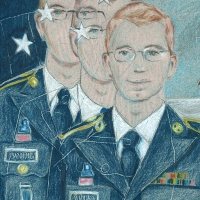
Those of us who covered Chelsea Manning’s court martial at Ft. Meade relied on the drawings of artists in attendance to illustrate our coverage of witnesses testifying, dramatic proceedings, and vital courtroom moments. Debra van Poolen, one such artist, wrote about her experience here. I’ve thanked Debra in a piece explaining the value of her and others’ images, first published here at WARP Place. Relatedly, see artist Clark Stoeckley’s book-length graphic account of the trial here.
We are, increasingly, a visual people, overloaded with imagery at every turn. Thus the army’s (and administration’s) strategy to turn what should have been a trial available to the public for witness, conversation, and debate into a covert one made sense. No cameras, no cell phones, no computers in the courtroom. Metal detectors scanned our every inch for a hidden lens or wire. Uniformed muscles with weapons lined the walls, escorting us out to stretch our limbs and rest our eyes, watching, retrieving us. In the media room, a relaxed appearance betrayed an even more sinister crackdown on any attempt to publicize the show trial of U.S. Army Private Chelsea Manning.
By and large, the mainstream media ignored the trial. We few reporters followed proceedings on a delayed video feed, that—just next door to the NSA, capable of spying on Americans’ every communication—was conveniently, annoyingly liable to cut out at any minute, for several at a time. So adverse was the Army to the public witnessing the immense, inexorable courage of a 5’2” soldier who stood head and shoulders above her fear-stricken fellow servicemen that when a few seconds of video did seep onto the world wide web, Ft. Meade soldiers with handguns were assigned to patrol the media room, their hot breath on our necks as we tried to transcribe extensive motions in real time. Continue reading “On the import of Debra Van Poolen’s artistic witness”
Alex Gibney’s response to my ‘We Steal Secrets’ review
Documentary filmmaker Alex Gibney responds in full to my critical review of his film on WikiLeaks whistleblower Chelsea Manning, “We Steal Secrets”

On May 24, 2013, I reviewed Alex Gibney’s WikiLeaks/Bradley Manning film ‘We Steal Secrets,’ focusing on its portrayal of Pfc. Bradley Manning. Read that review here. Alex Gibney wrote me a letter in response, reprinted in full below:
Dear Nathan:
I read your recent review of “We Steal Secrets: the Story of WikiLeaks.”
I have great respect for the work that you have done and continue to do on behalf of Bradley Manning. With that in mind, let me express my disagreement with a number of your assertions about my film. I do not expect you to share my views, but I would hope that you hear them. Continue reading “Alex Gibney’s response to my ‘We Steal Secrets’ review”
What ‘We Steal Secrets’ leaves out
The portrait of Manning is one of pity more than empathy, that makes us feel bad for Manning rather than take a serious interest in [her] beliefs and plight
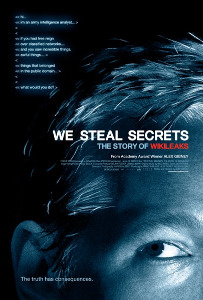
This review was first posted here on May 24, 2013.
Alex Gibney’s “We Steal Secrets” chronicles WikiLeaks’ front-page, world-shocking 2010 leaks from inception to publication to aftermath, framing WikiLeaks’ work as a meteoric rise giving way to a self-incurred implosion.
While I find fault with this view, and even its premise that WikiLeaks has failed and died (the site continues to publish Stratfor emails and Kissinger files, it just won an important Icelandic victory to resume accepting donations through Visa interlocutors, and the Freedom of the Press foundation continues to funnel anonymous contributions its way), I’d rather let others dissect its portrayal of Assange and WikiLeaks and instead focus on how it characterizes Bradley Manning. (Read WikiLeaks’ annotated copy of the film’s script here.)
Earlier this year, we took issue with some of director Alex Gibney’s comments associating whistleblowing with alienation, pathologizing Manning’s leaks and undermining his political values. Producer Sam Black emailed to assure us that, in fact, Bradley Manning is “a hero in the film. He is the moral and emotional center of a complex story about what should and should not be secret.”
Though the movie does laudably transition away from its opening focus on Julian Assange by reminding viewers that Manning is the courageous whistleblower who deserves at least as much public attention, Manning’s story only makes it into about a quarter of the two-hour film, which quotes journalists, former WikiLeaks members, high-ranking government officials, and fellow soldiers.
The time that is spent on Manning leaves much to be desired, and what it leaves out is as much to blame as what it includes. Ultimately, the resulting portrait of Bradley Manning is one of pity more than empathy, one that makes us feel bad for Manning rather than take a serious interest in his beliefs and his plight. Continue reading “What ‘We Steal Secrets’ leaves out”
The United States cannot win its war on Chelsea Manning
(By Russell Fuller) Goliath fears this David. And because that’s been revealed at Fort Meade to the witnesses gathered there and the rest of us who are paying attention, the United States has already lost this war too.

By Russell Fuller
The United States cannot win its war on Bradley Manning. Though it sent a somewhat fragile young man off to war in Iraq, it produced instead a committed humanitarian; though it has caged him without trial for three years, one of them in torturous solitary confinement, it produced instead a fine, free spirit; though it brings its full weight to bear on a man who stands but five-foot two and tips the scales at one hundred and five pounds, it simply steeled his spine; though it restricts public access to pre-trial hearings and, in contradistinction to the First Amendment, threatens the meager group of gathered journalists and witnesses by stating today that access is not a right but a privilege, it produces instead a hunger for truth. Continue reading “The United States cannot win its war on Chelsea Manning”
Bradley Manning’s torture hearing
For the last three weeks in Ft. Meade, MD, Bradley Manning has had a pretrial motion hearing to seek accountability for the abusive treatment he endured at the Quantico Marine brig in Virginia, from July 29, 2010, to April 20, 2011.
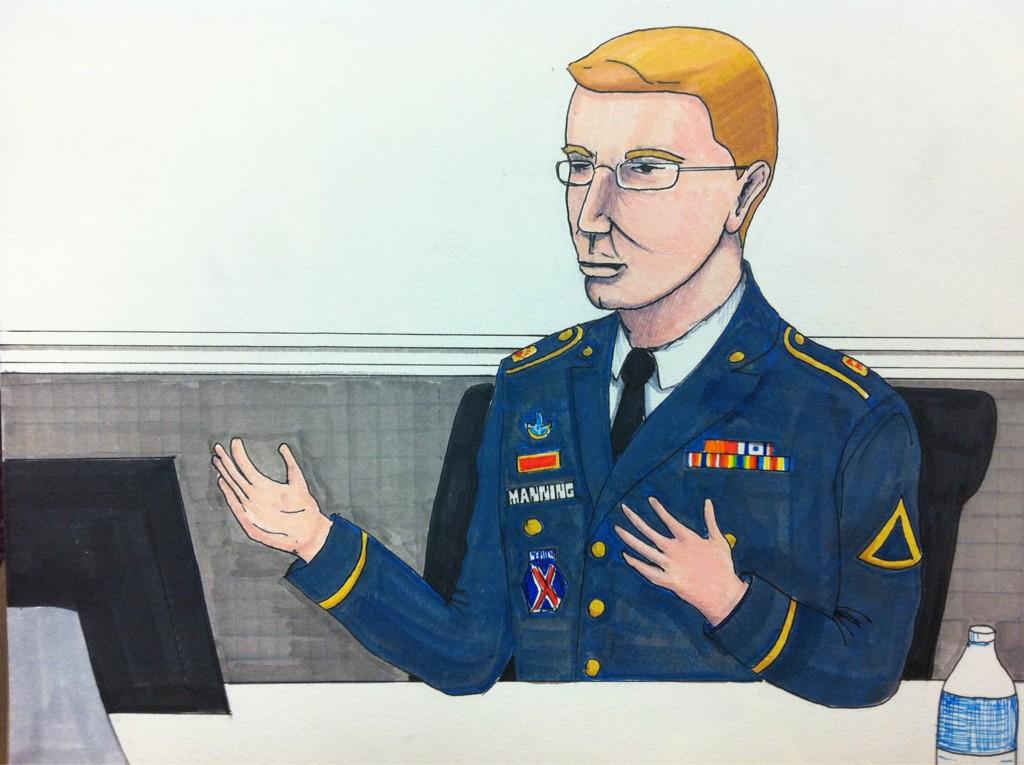
Update: I’ve posted a lengthier summary of this hearing and Manning’s testimony here.
For the last three weeks in Ft. Meade, MD, Bradley Manning has had a pretrial motion hearing to seek accountability for the abusive treatment he endured at the Quantico Marine brig in Virginia, from July 29, 2010, to April 20, 2011. Manning was on Prevention of Injury watch (POI) or Suicide Watch his entire time in the brig, isolated in a 6×8 ft cell for 23 hours a day. For the first six months, he got only 20 minutes of sunshine a day. For the last month and a half, he had to surrender his underwear at night. For his entire time there, he was monitored around the clock, he had to ask for toilet paper and soap, and he had to wear metal shackles any time he left his cell. There weren’t detainees next to his cell, and when he left his cell the brig went in lockdown, so he was effectively barred from speaking to other inmates. And the military used his poor communication to justify his treatment.
About a dozen Quantico officials testified for several hours each to explain that Manning’s conditions were in his own interest: most said they thought he was going to kill himself because he made two nooses in prison in Kuwait — when he was left in a cage and no explained what was happening to him, he broke down. Yet Manning hasn’t hurt himself once at Ft. Leavenworth. Others said that because of the national security implications of Manning’s charges, and the fact that other detainees were “very patriotic,” that Manning was in danger of being attacked — they couldn’t explain, however, why he wasn’t put in protective custody (which has many fewer restrictions), or why he hasn’t been attacked while in medium security for a year and a half in Ft. Leavenworth.
This is painfully counterproductive. As professor Craig Haney — who defense lawyer David Coombs cited in court — told Congress:
Prisoners in long-term solitary confinement suffer psychological breakdowns from the lack of human contact that can lead to psychosis, mutilations, and suicide…
The military wouldn’t concede that Manning was held in solitary confinement. But in the portion Coombs quoted, Haney explains how prison officials use different terms to conceal these conditions:
I should acknowledge that the term “solitary confinement” is a term of art in corrections. Solitary or isolated confinement goes by a variety of names in U.S. prisons—Security Housing, Administrative Segregation, Close Management, High Security, Closed Cell Restriction, and so on. But the units all have in common the fact that the prisoners who are housed inside them are confined on average 23 hours a day in typically windowless or nearly windowless cells that commonly range in dimension from 60 to 80 square feet. The ones on the smaller side of this range are roughly the size of a king-sized bed, one that contains a bunk, a toilet and sink, and all of the prisoner’s worldly possessions. Thus, prisoners in solitary confinement sleep, eat, and defecate in their cells, in spaces that are no more than a few feet apart from one another…
Manning didn’t even get these “worldly possessions.” No matter what the military wants to call it, Manning was in solitary confinement.
The defense is moving to dismiss all charges based on this abusive treatment, based on the Article 13 prohibition against pretrial punishment. As an alternative, if the judge won’t through out the case, the defense requests at least 10-for-1 sentencing credit for the time Manning was in these conditions. Judge Lind is reviewing testimony and will probably rule in a few weeks. We return to court January 8-11, 2013.
There’s much more to unpack in each report, and I’d like to expound on how the chain of command ensured Manning never got out of solitary, but here for now are my summaries from the courtroom:
Day 1.
Day 2.
Day 3.
Day 4.
Day 5.
Day 6.
Day 7 & 8.
Day 9.
Day 10.
Day 11.
2012 albums
Ten of my favorite albums from 2012, mostly for posterity, in no particular order — check here for links to a playlist and a favorite song from each album

 Some of my favorite albums from this year
Playlist: 2 songs from each. Links below go to full albums.
Hot Chip // In Our Heads
Kendrick Lamar // Good Kid M.A.A.D. City
Beach House // Bloom
Pet Shop Boys // Elysium
Grizzly Bear // Shields
The Shins // Port of Morrow
 Frank Ocean // channel ORANGE
David Byrne & St. Vincent // Love this Giant
The Magnetic Fields // Love at the Bottom of the Sea
Grimes // Visions
Leniency for generals, jail time for whistleblowers
Bush administration torturers are on book tours while torture whistleblowers are on trial. Wall Street executives are counting their bonuses while foreclosed homeowners are packing their bags. Life’s not fair
Or, the National Insecurity State
[Many thanks to Antiwar, Counterpunch, and Dissident Voice for running this piece first.]
It’s no secret that the powerful in America are frequently immune to prosecution for committing far worse crimes than those by the powerless. Bush administration torturers are on book tours while torture whistleblowers are on trial. Wall Street executives are counting their bonuses while foreclosed homeowners are packing their bags. Life’s not fair.
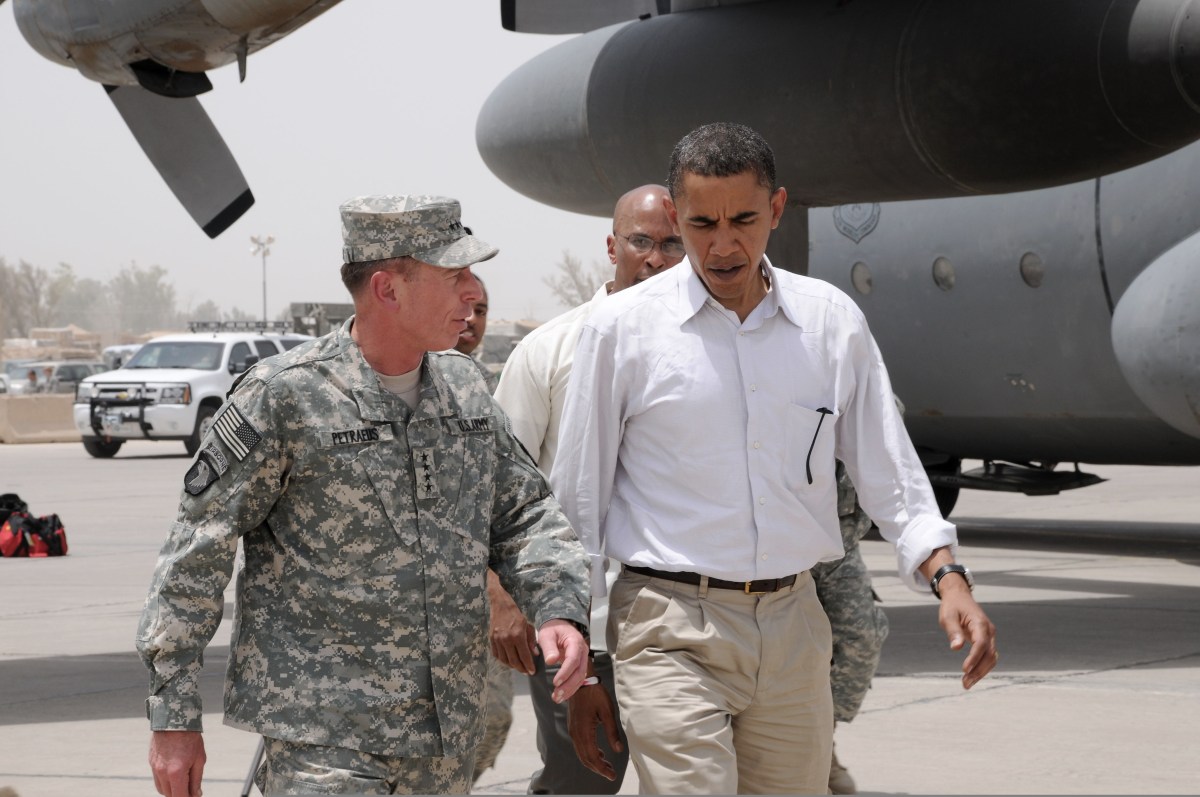
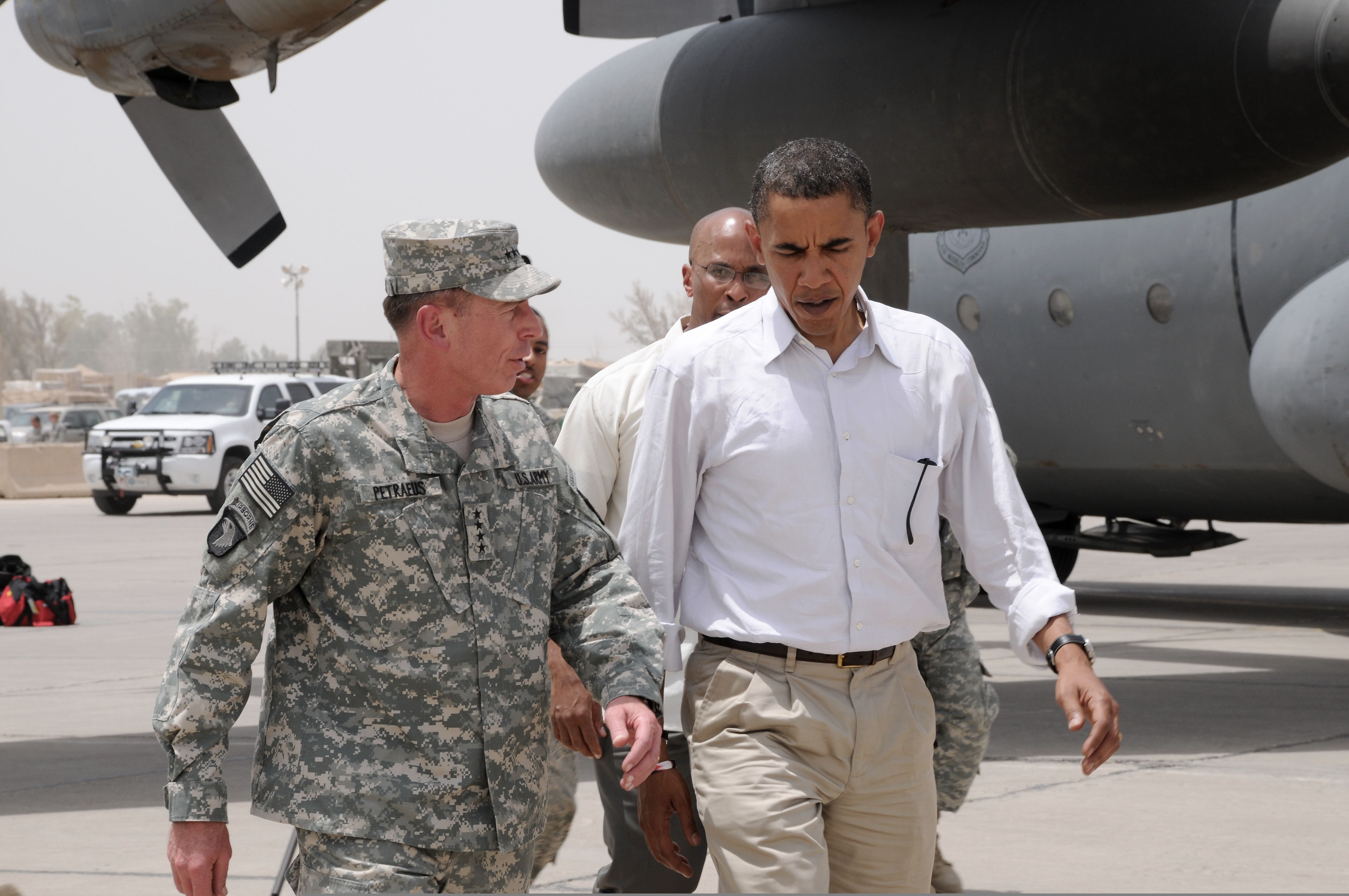
That’s one reason why it was so startling to see Gen. David Petraeus resign upon learning the FBI had discovered his extramarital affair with biographer Paula Broadwell. Surely, the director of the accountability-free, drone-happy CIA could sleep around as he pleased and not fear a fellow government agency would rat him out, right?
Ah, the unexpected pleasures of the ever-growing security state. It turns out the FBI found out that Petraeus shared more than a bed with Broadwell — likely his emails, rife with classified information, too, though he claims that Broadwell got the information from officials in Afghanistan. And this administration hates nothing more than the unintended release of classified information: despite anonymously leaking favorable-but-Top Secret information to The New York Times on a weekly basis, the Obama administration has tried to use the Espionage Act to convict whistleblowers more often than all previous administrations combined.
But not so fast. Gen. Petraeus is still their man, with a reputation to uphold. So when President Obama was asked about the potential security breach, he said, “I have no evidence at this point, from what I’ve seen, that classified information was disclosed that in any way would have had a negative impact on our national security.”
The statement is crafted to appear interested in the good of national security, to appear to put America’s safety first. But the subtext says much more: There may have been a classified disclosure that didn’t impact national security at all, or that did so positively, but that isn’t a problem.
These comments directly contradict government arguments in a much bigger ongoing investigation: that of WikiLeaks and Pfc. Bradley Manning. Cutting off Manning’s ability to argue that he was a whistleblower, who knew that the information WikiLeaks released wouldn’t bring harm to national security but instead would properly inform the American citizenry, the government prosecution has fully precluded discussion of whether or not WikiLeaks’ releases brought harm to national security from the trial. Even conceding that WikiLeaks’ release of hundreds of thousands of documents may not have harmed national security, the government says the effect is irrelevant to Manning’s guilt or innocence.
But Gen. Petraeus — or any of the other high-ranking officials who leak Top Secret information, a classification level higher than anything Pfc. Manning is accused of releasing — will not be held to this standard.
This is the chilling effect on whistleblowing: share classified information with a biographer selling books by glorifying your war-making, and your president assures the press that you’ve caused no harm; share crimes, uncounted civilian casualties, and corporate backroom dealing with your fellow taxpaying citizens, and you face a potential life sentence in prison, not to mention nine months of confinement abuse, an extensively delayed trial, and your president’s declaring you guilty before trial.
Time and again, Bradley Manning is stepped on so the military can discipline dissent and discourage those he might inspire. Meanwhile, the prurient press is more curious about Petraeus’s sex life than the growing security state and the whistleblowers trying in vain to stop it before it consumes us all. We cannot afford to abide this double standard any longer.
“Why can’t you be reasonable?” asks judge in the case to end secrecy in Bradley Manning’s trial
Judges questioned why the government forced the issue to come to court at all, instead of simply making the documents public.
[This post was first published at BradleyManning.org — view it there.]
The CCR argued its case at the Court of Appeals for the Armed Forces today for transparency in Bradley Manning’s court-martial trial. Judges questioned why the government forced the issue to come to court at all, instead of simply making the documents public.
By Nathan Fuller. October 10, 2012.

During oral arguments in the Center for Constitutional Rights’ lawsuit against the government seeking public access to basic court documents in Bradley Manning’s court-martial trial, judges for the Court of Appeals of the Armed Forces demanded the government explain why it wouldn’t simply provide these documents in the first place.
When Army lawyer Capt. Chad Fisher said that the court wasn’t constitutionally required to provide public access to documents like prosecution briefs, transcripts, and rulings, Judge Margaret Ryan interrupted him to ask what she called a “common sense” question.
“Why can’t you just give it to them? Instead of making this a constitutional case, why can’t you just be reasonable?”
Fisher was unable to directly answer the question. Instead, he gave an array of responses that circumvented the basic issue: he repeated his belief that the court wasn’t obliged to make these records public, he said the fact that the public could attend the hearings meant they were “open,” he complained that the defense wasn’t asking the proper authority, and he reiterated the government’s position that the availability of FOIA provided sufficient public and press access.
The five judges repeatedly questioned and challenged each of Fisher’s points, particularly the idea that FOIA requests, to which the government frequently takes weeks, months, or even years to respond, provided sufficient and contemporaneous access, especially considering the fact that FOIA requests in this case have already been denied. They also pushed back on Fisher’s claim that “Nothing has been withheld” from the public and the press, based on the idea that attending the hearings amounts to fully accessing the proceedings.
“How is oral argument sufficient if you can’t read the briefs?” one judge asked.
“It’s not as if they’re speaking a foreign language,” Fisher responded.
But as journalists from the 30 major media outlets who submitted a supportive brief in this case explained, the media (and therefore the public) needs these documents to adequately cover the case:
“Journalists rely heavily on court documents to gain and provide to readers the background of and context surrounding a legal controversy — awareness and understanding of which is often necessary to accurately report on the dispute. Prior access to the materials also allows reporters, the overwhelming majority of whom have no legal background or education, to process the oftentimes complex legal theories at their own pace, or to interview a legal expert who could explain the issues, so they are better equipped to understand what is transpiring in a proceeding they attend.”
Shayana Kadidal, the CCR lawyer arguing in court today, similarly contended earlier this year that providing openness-in-name-only effectively “choked off” coverage of Manning’s hearings.
But the judges, not seemingly satisfied with Fisher’s responses, kept returning to the more elemental point that the government could avoid this litigation and a potential ruling that would affect courts-martial to come by simply turning over the documents requested. The court already has a process in place to redact documents, the judges noted, and parties settle extrajudicial matters with a compromise out of court all the time, so it seems perfectly feasible for the government to comply with the CCR’s reasonable request for access to the documents.
In the midst of this questioning, Fisher did concede what the CCR has long observed: that Guantanamo tribunals – hardly beacons of transparency – were less secretive than Bradley Manning’s court-martial, because the public could access filed briefs and transcripts to those proceedings.
The CCR’s Kadidal fielded a similar though not quite as lengthy barrage of questioning from the appeals court judges. The first issue they raised was whether this court even has jurisdiction to make a ruling on this case, as their jurisdiction has been narrowly limited and it isn’t clear that they have standing to make a ruling that affects the press and public alike. Kadidal responded that the government hadn’t raised this issue in their replies, and so he would need an additional 10 days to file a supplement that addresses the court’s jurisdiction.
Judge Ryan also wanted to know whether there was precedent for this court to compel the production of documents that didn’t yet exist. She was referring to the CCR’s request for transcripts of RCM 802 conferences, the private telephonic meetings Judge Denise Lind holds between Ft. Meade hearings with both the defense and the prosecution. She also wanted Kadidal to account for how exactly the documents would hypothetically be produced: who would transcribe the hearings, or who would pay a stenographer?
Kadidal responded that an audio file would be acceptable, but on the issue more generally, he said he believes the court should make a First Amendment ruling granting the press the right to these documents and let lower courts adjudicate the logistics. Judges replied that it was unclear that the First Amendment affords contemporaneous access to these documents: in other words, it might be wholly constitutional for the court to provide these documents after the fact.
Kadidal will submit his jurisdictional supplement in 10 days, and the government will submit a reply less than a week later. It’s unclear when or if this court will issue a ruling, or when exactly the parties might return to court. We’ll update our coverage of this case as it unfolds.
Rule of law abandoned for Bradley Manning
The Marines and Army have violated their own code of justice in several ways, for several months, precluding a fair trial and making a mockery of the rule of law.

(This post first appeared at the New Matilda and then at Antiwar.)
 Bradley Manning’s critics need to be more careful if they want to accuse him of breaking the law. The real outrage is the way prosecutors and the military more broadly have handled his case: the Marines and Army have violated their own code of justice in several ways, for several months, precluding a fair trial and making a mockery of the rule of law.
The complaints of critics reveal the fundamental hypocrisy in Manning’s case — the rule of law is not applied evenly. While war criminals, torturers, and known murderers walk freely, the military is aggressively punishing the messenger who exposed heinous crimes and rampant abuse. Prosecutors go beyond disciplining a soldier for stepping out of line, attempting to associate whistle-blowing with terrorism by charging Manning with “aiding the enemy.”
The most prominent injustice is what drew many to Manning’s plight in 2011: his abusive, brutal, and illegal treatment at the Quantico Marine Brig. Against nine months of recommendations of brig psychiatrists, Bradley saw sunshine only 20 minutes each day, was kept in solitary confinement, was put on prevention of injury watch, and was forced to stand nude nightly. The military says these conditions were in Manning’s best interest, that he was a suicide risk and without this treatment he would’ve harmed himself.
Newly surfaced emails reveal the truth: that three-star Lt. Gen. George Flynn, removed from Quantico and likely taking orders from the Pentagon, ordered Manning’s abusive treatment and ignored psychiatrists to keep Manning in solitary confinement. Such treatment is clearly punitive and therefore a violation of the Uniform Code of Military Justice (UCMJ). Manning’s lawyer, David Coombs, is motioning to dismiss charges based on this punitive treatment on 27 November. We’ll see if Judge Lind will hold the Marines accountable.
By the time that motion is argued, Manning will have spent 919 days in prison without a court martial. A speedy trial would’ve started nearly two years ago. Instead, delay after delay pushes litigation back further. Critics note that David Coombs had to ask for several delays, pushing the trial back himself. But in several cases, delays arose because the prosecution explicitly withheld basic documents that were material to the defence. For example, on 26 July, at 7:50 PM, just hours before the defence filed the motion to dismiss based on pretrial punishment, the prosecution handed over 84 emails relating to that punishment and revealed that there were 1290 more, which it later turned over in court. The prosecution sat on those emails for at least six full months before giving them to the defence at the eleventh hour, forcing Coombs to delay litigation of the motion to dismiss.
Similarly, the prosecution stalled in handing over thousands of discovery documents regarding the State Department’s reaction to WikiLeaks’ releases, and only did so when Lind finally forced their hands.
But how can Lind fairly adjudicate a trial that has already been ruled on by her superior officers? In April 2011, President Obama, Commander-in-Chief of the Armed Forces whom all inferior officers answer to, decreed that Bradley Manning “broke the law“. Echoing his commanding officer in March 2012, General Martin Dempsey, Chairman of the Joint Chiefs of Staff, said that Manning “did violate the law“.
Dempsey and the President should take note: it is unlawful command influence and a direct violation of the Uniform Code of Military Justice for either of them to have declared Bradley Manning guilty before trial. Both officials may say their comments were off-hand, but the message has been clearly sent to the judge, Col. Denise Lind — to rule in favor of Bradley Manning is to contradict your commanding officers.
So throughout these lengthy pretrial proceedings, PFC Manning’s due process rights have been deprived or infringed upon in many ways. But even before the process began, we knew that the rule of law was not being applied evenly. Instead, it’s aggressive persecution for the conscientious soldier and leniency or full immunity for officials in power.
Look at the treatment given to the war criminals that Manning exposed.
None of those revealed in the Collateral Murder video to have killed innocent Iraqi civilians and their rescuers have been prosecuted. None of the soldiers who handcuffed and summarily executed an Iraqi family, including women and toddlers, are on trial. Those who have been caught committing mass atrocities have been given light punishment, if any. Staff Sergeant Calvin Gibbs, ringleader of the “Kill Team” in Afghanistan that murdered unarmed civilians and took their body parts as souvenirs is in prison, but is eligible for parole in less than 10 years. Marine Staff Sergeant Frank Wuterich, who ordered the 2005 Haditha massacre that killed 24 innocent Iraqis (including children), got no jail time at all. None of the Marines who carried out the killings were even prosecuted.
Several more WikiLeaks revelations uncovered criminal acts. Hillary Clinton ordered US officials to spy on members of the UN. US officials covered up child abuse by Afghan contractors. The former president of Yemen took credit for attacks in his own country carried out by the United States. None of them face trial.
So much for the rule of law that Bradley Manning’s critics tout so widely. Those who commit war crimes get leniency or a welcome-home golf tournament; those who expose war crimes face life in prison without parole, and solitary confinement before trial to boot.
Bradley Manning summer recap
My Bradley Manning coverage from this summer all in one place. Check here for courtroom reports, a few articles, and radio interviews. I’ll continue to add more to this recap in the coming days
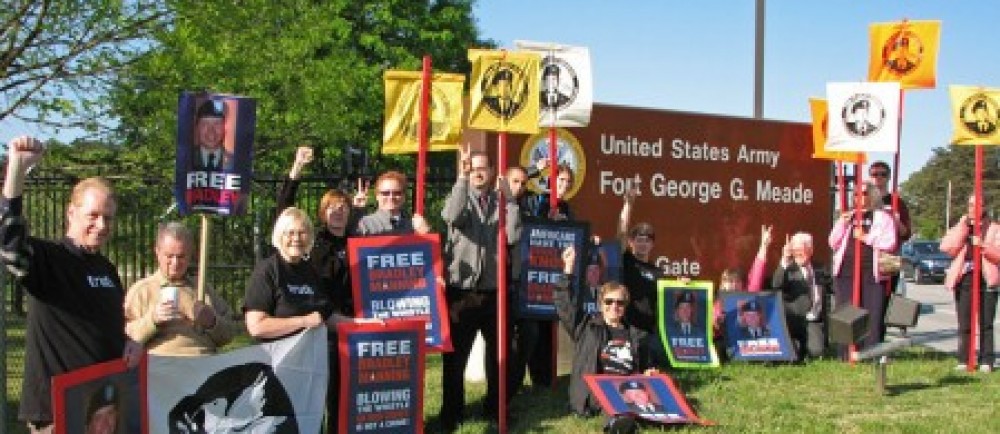
I’ve neglected this blog due to my increased and still increasing role with the Bradley Manning Support Network, and you can still find all of my recent writing at BradleyManning.org. But I want to collect my Bradley Manning coverage from this summer all in one place. Below are hearing reports, a few articles, and radio interviews. I’ll continue to add pieces to this recap in the coming days.
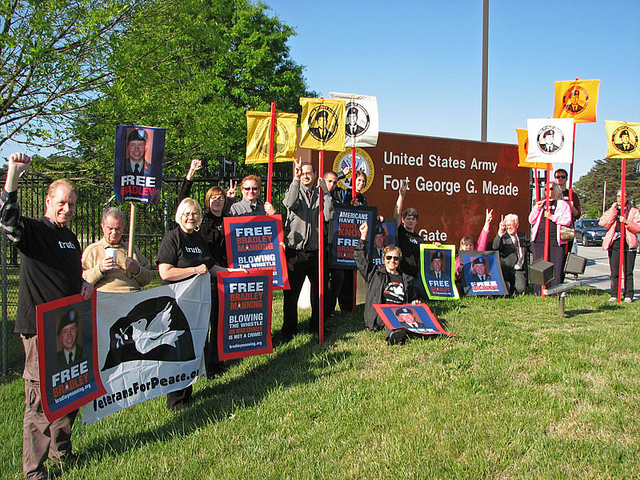
Reports from Ft. Meade
Articles
Incompetence or deception? Two years of evasions by the prosecution: “There is more secrecy surrounding the U.S. military’s ongoing prosecution of PFC Bradley Manning than the much-criticized Guantanamo Bay trials.. The hearings aren’t closed-door sessions, but more insidiously, they include no public records, no transcripts, and no public motions from the government. They provide so little media access that the Center for Constitutional Rights and several media organizations are suing the military for more transparency. The lawsuit follows protests from acoalition of media figures who say that they have been blocked from accessing even basic information about the trial.”
Debates, discussions, and reforms: “WikiLeaks immediately upended journalism as we knew it, filling newspapers with more revelations than editors knew what to do with, more scoops in a year than most journalists get in a lifetime, and more source documents than American journalists had ever had access to before. WikiLeaks blew holes in the wall of U.S. secrecy, and the world is better for it. As Julian Assange turns 41 in political limbo in Europe, and as Bradley Manning nears 800 days in jail without a court martial, we remember how much good WikiLeaks’ releases have done.”
Aiding the public is not “aiding the enemy”: “The prosecution contends that Manning can be charged with “aiding the enemy” if he merely knew that a third party, and in this case America’s enemies, could access information he released online. But Coombs argues, as the ACLU has argued, that this is wildly overbroad, leaving any information a soldier posted online vulnerable to this type of prosecution.”
Bradley Manning, military resistance, and the left: “While this bodes well for the resistance movement and may help breathe new life into antiwar coalitions, it lacks the urgency required to save Bradley Manning now. Ensign observed, “It’s easy to sit in forums and call for [Bradley’s] freedom, but the reality is there’s lots of work left to be done.” Indeed, we who wish to free Bradley from his unwarranted chains have under five months before his court martial trial, in which prosecutors aim to send him to prison for life without parole. Bradley’s case raises scores of issues in the abstract, but we must remember that Bradley Manning the person faces very real punishment for believing his fellow Americans deserved to know what their government does in secret.”
Radio Interviews, other
 Nathan Fuller